We often talk about professional achievements, tech stacks, and complex projects. But behind every specialist, there is a living person with their own hobbies, dreams, and simple joys. On the eve of March 8, we decided to learn about our colleagues' personal experiences working in IT.
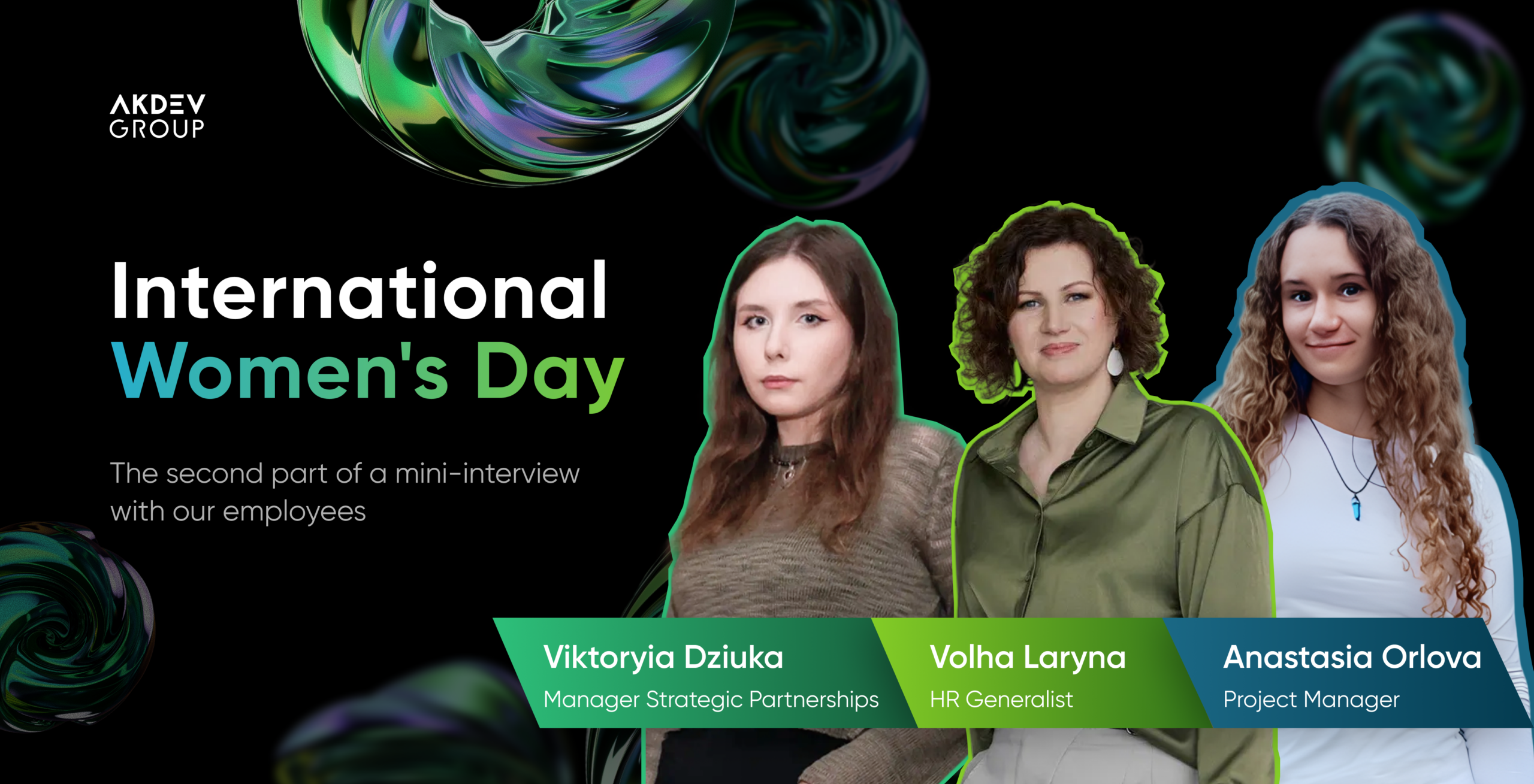
Viktoryia Dziuka works as a Strategic Partnerships Manager. Olya Larina is an HRBP specialist, and Anastasia Orlova is a Project Manager. They will share their thoughts on careers, stereotypes, and work-life balance.
How would you describe your career path?
Olya: My career path was quite unconventional. I literally "ran away" from accounting into recruiting. In my recruiting courses, I was the oldest student in the group. And honestly, there were moments when I wanted to give it all up. Perhaps, if it weren't for the support of my mentor, Anastasia Shirkina 🔔, I wouldn't have dared to go further.
After training, I started as a sourcer. Then I grew to lead a team of sourcers. And it was at that moment that I realized, I like discovering people, seeing their potential, and helping them grow. Over time, my focus shifted from operational work to a more strategic role. Today, for me, recruiting is about the right team structure, long-term workforce strategy, and impact on performance and business sustainability.
My path is an example that a career change is possible at any age if you have the internal readiness to grow.
Anastasia: Well, I'd say my career path turned out to be diverse because I was really tossed around a bit. I initially wanted to go into business analysis, but I ended up in process engineering. I've never seen a business analyst capable of drawing a fully executable BPMN diagram and working with autotests in Kotlin. That's closer to systems analysis. Actually, that's where I later moved thanks to these skills. And then at some point, just on a project, I was offered to combine the roles of analyst and manager, and I agreed.
Are you happy with how things have developed now?
Anastasia: Yes, because I have a feeling that management suits me better than analysis, because it's more dynamic.
What stereotype do you encounter most often?
Olya: The most persistent stereotype is age. A woman in business always seems to be in the "wrong place". Too young, meaning inexperienced - older, meaning no longer flexible. In reality, age determines neither ambition, nor the ability to learn, nor strategic thinking. I really appreciate that in the North American market, depth of experience, adaptability, and a growth mindset are increasingly valued, not the number in the passport.
Anastasia: Perhaps the most common stereotype is related to remote work. Some people think that with such work, the whole day is free. They overlook the fact that it's still a job. Like everyone else, we have a full workday and tasks that need to be completed.
What quality helps you be effective?
Olya: I think it's the combination of empathy and systems thinking. Empathy helps to see the living person behind the resume and KPIs. I see the motivation and potential. Systems thinking allows me to turn this understanding into clear processes, honest metrics, and solutions that support both people and the business. For me, HR is a bridge between the team and the company. It's the balance of human insight and business metrics that makes my work effective.
Anastasia: I'd say it's the ability to negotiate, especially with my team. When a manager and the team are on the same wavelength, even the most complex issues are resolved more effectively.
Viktoryia: Probably the ability to listen and understand people. When you genuinely try to understand a person's needs, rather than just trying to sell something, communication goes much more smoothly.
How do you find a way to connect with someone who is initially skeptical?
Viktoryia: I try not to push. I just ask questions to understand what exactly is causing the doubts. When a person sees that you're not being pushy, but are trying to understand their situation, they usually become more open.
Everything changes fast in IT. How do you build long-term relationships with clients?
Viktoryia: I try to stay in touch and maintain transparent communication. If deadlines or requirements change, it's important to be honest about it and respond quickly.
You see hundreds of resumes. What most often prevents talented women from getting into IT?
Olya: Most often, it's not a lack of skills, but rather undervaluing their own achievements. The market is indeed competitive, and requirements are high for everyone. But I often see one pattern:
Men apply even if they meet 60–70% of the requirements, while women often hesitate if they don't see a perfect match.
Olya: In terms of work quality, depth of technical thinking, and responsibility, I don't see a gender difference. I've worked with strong female developers, DevOps engineers, and system administrators who demonstrated a high level of expertise and leadership.
How do you create an atmosphere where people feel comfortable working?
Olya: For me, the priority is transparency, openness, and predictability. People are truly comfortable when expectations and areas of responsibility are clear, feedback is honest and regular, decisions are explained. I believe that culture formed daily in how we give feedback, how we conduct calls, how we discuss mistakes, and how we make decisions. A comfortable environment isn't about the absence of challenges. It's about psychological safety and respect, even in moments of disagreement.
What superpower is needed to make an office a place where people want to come?
Olya: The superpower is to give the team the freedom to come to the office voluntarily and not waste time in traffic jams. People go where they are respected, heard, it's safe to express opinions, and there's a feeling of team, not internal competition. If the atmosphere is healthy, people choose to come themselves.
How do you manage to organize schedules, meetings, daily life, and stay calm when everything is on fire?
Anastasia: Firstly, it's a clear understanding of priorities. When you have that, it's easier to plan your tasks, no matter how many there are, and stick to the plan. Secondly, I always set aside time for rest and recovery, but I don't plan the activities themselves; I do what I need in the moment.
Was it difficult at first to take on a managerial position? What difficulties did you face at the beginning of your journey?
Anastasia: The biggest difficulty was the overall lack of experience. However, I was always surrounded by more experienced colleagues who could offer advice if needed, for which I am grateful.
How do you recharge your energy after a busy day?
Olya: Sometimes it's a long walk in the fresh air, sometimes the theater or Pilates. And sometimes, just an evening with a favorite show. The main thing is to have a moment when you can switch off from work and get back to yourself.
Anastasia: I have several hobbies that allow me to shift my focus. Mainly, it's several types of sports that I combine. Also, depending on my mood, I do dancing and drawing.
Viktoryia: Usually, something simple helps: a walk, sports, or just switching off and not thinking about work for a couple of hours. It really reboots the brain.
If you could give one sentence of advice to your 18-year-old self starting a career, what would you say?
Olya: Don't wait for permission to be ambitious. If you have ambitions, it means you have the strength to achieve whatever you want. Don't be afraid to make mistakes, start from scratch, and don't compare yourself to others — most often, the ceiling exists only in our minds.
Anastasia: I would say believe in your strength more. Nothing is impossible, any problem can be solved, and you can learn anything.
Do you have friends or role models among your colleagues?
Olya: I don't have one single role model, but there are people who inspire me. You can pick up something valuable from each: from Josh Bersin it's HR trends; from Frances Frei, ideas about leadership and corporate culture; from Laszlo Bock, approaches to employee development. Of course, I can't immediately use everything they suggest. It's important to filter, try what's suitable here and now, and leave the rest for the future or adapt it to my own tasks.
We’re grateful to Olya, Anastasia, and Viktoria for their honesty and for the work they do every day. Our employees have proven that women are very multifaceted individuals who can be true professionals. Thank you to each of you for your professionalism, for your passion, for your courage to try new things, and for being a part of our big team.
Happy holiday to all the women! May everything you dream of come true!